Pool Deck Resurfacing Options in Brevard County
A worn concrete pool deck in Brevard County has four ways forward. You can choose a knockdown spray texture, a stamped overlay, thin pavers over the slab, or a new paver deck. The first three keep your old slab, so they only work if that concrete is still sound.
Which one fits depends on your slab first and on the look you want second. A deck that has heaved or sunk needs the fourth option, whatever finish you had in mind.
We lay pavers and pour concrete, so every option your slab allows gets priced on one visit. The prep and finish work behind the first three is on our pool deck resurfacing page.
Is your pool deck a candidate for resurfacing?
Start with the slab, since three of the four options sit on top of it. An overlay bonds to the old concrete, so it can’t fix problems below the surface. A deck that is heaving or has severe cracks rules out every overlay, whatever the finish.
A good candidate looks tired but sits still. One pool deck guide lists fading, staining, spalling and a worn texture as cosmetic damage an overlay can cover. The same guide says cracks should be narrower than about a quarter inch. Cracks like that get cut out and filled first, so they don’t mirror through the new surface.
Replacement is the better call when sections heave or sink, or when the base under the slab has washed out. Brevard’s sandy soil drains fast but settles, so a corner near the pool can drop. Resurfacing will not solve a soil problem. That deck comes out, and a new paver pool deck on a compacted base is the rebuild we would price.
Each option asks something different of a sound slab. A spray texture coat is thin, so it moves with whatever the concrete under it does. A stamped overlay bonds the same way, and poor prep is the most common reason overlays fail. Thin pavers need a flat, stable slab, because the slab carries the load and the pavers carry the look.
How do the four options look and grip when wet?
A knockdown spray texture coating gives the deck one even, gritty texture in the color you pick. The mix gets sprayed on, then a trowel knocks the peaks flat for a smoother feel. The highly textured surface is slip resistant, which is why these coatings are common around pools. It suits a deck that needs grip more than a pattern.
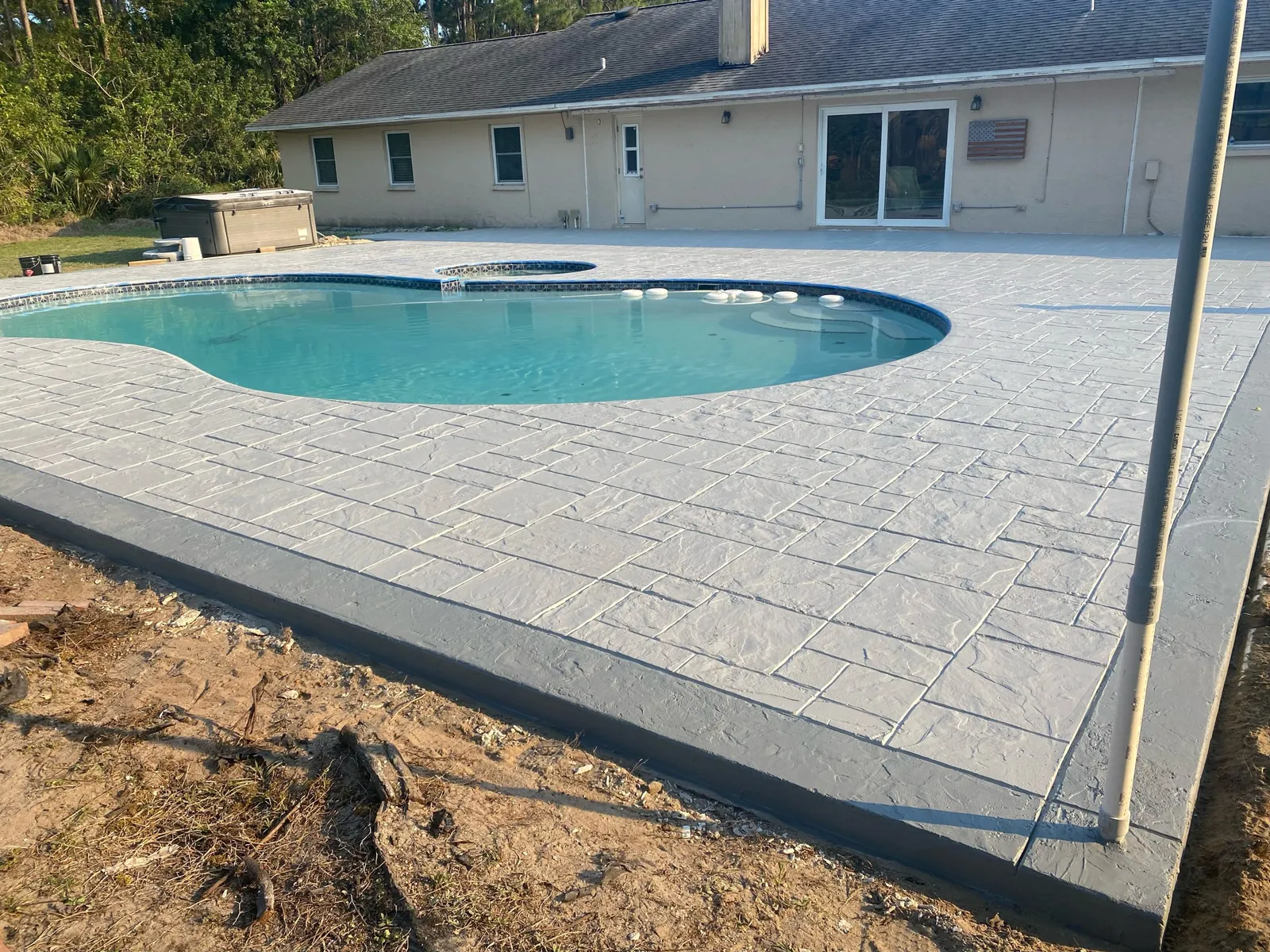
A stamped concrete overlay suits a deck where you want a pattern. We stamp ashlar slate, flagstone, brick and wood plank, with a base color and a release color. Grip on a stamped surface depends largely on the sealer. Sealed decorative concrete can get slick when water beads up, so our sealer goes on with a grit additive.
Thin pavers set over the old slab give you a real paver surface. The field can run in herringbone or running bond, with a border. A new paver deck gives the same look at full thickness, with paver coping and a bullnose edge. Pool deck guides rate concrete pavers as durable and slip resistant.
How much height does each option add?
Height matters most where the deck meets something fixed. That means the sliding door threshold, the screen track, the deck drains and the coping. A spray texture goes on thin, close to a skim coat, so the deck height barely changes. A stamped overlay starts at about a quarter inch, and deeper patterns need more material.
Thin pavers lift the deck about an inch and a half once they are set. That lift shows up first at the slider track and the door threshold. Thin pavers fit a deck with room to rise at both. A new paver deck is rebuilt from a fresh base, so its height gets planned from the start.
Deck drains get the same check, because water still has to reach each grate across the new surface. Where puddles already sit for days, slope correction or a new drain comes before any finish. We measure all of these points at the estimate, before you pick a finish.
What happens at the coping edge?
Pool coping is the cap along the top edge of the pool, and every option has to meet it. With a spray texture or a stamped overlay, the old coping usually stays put. Thin pavers are the harder case, since their extra height lands right at the edge. Some decks keep the old coping with the pavers butted up to it, and some get new paver coping.
Check the coping before any resurfacing. Tap along it with a rubber mallet or a knuckle, and listen for a hollow sound. A hollow piece has lost its mortar bond, and it gets reset before anything else goes down. The pool stays full for that step, and the water level drops a few inches.
Whatever goes down, the joint between the coping and the deck stays soft. The pool and the deck move on their own, so the gap takes a foam backer rod and flexible sealant. A hard filler such as sand or grout passes deck movement straight into the coping.
Which pool deck surface stays cooler in the sun?
Start with color. Lighter shades reflect more sun and darker shades absorb more heat. That rule holds for every paving material. For pool decks, lighter colors are popular for that reason, since they keep the surface cooler.
Standard concrete absorbs and stores heat all day, so a bare deck in full sun gets hot underfoot. One pool deck guide calls spray texture popular for barefoot areas, since the subtle texture stays cool. Light spray textures are a standard pool deck coating across the Sun Belt. Pick the color from a real sample, since a printed chart is for reference only.
How long does each option keep you off the deck?
A spray texture has the fewest days of work. Most decks take a day or two of work, then a day or two of cure time. Light foot traffic is usually fine after about forty eight hours, and furniture goes back after about three days. Summer rain can push those days out, so spray days start early and follow the radar.
A stamped overlay takes more days on site. There is a narrow window to stamp the mix, and the sealer waits until the overlay cures. Thin pavers go down piece by piece, with cuts around posts, drains, curves and the screen track. A tear-out takes the longest, since demolition and haul-off come before the new base goes in.
What upkeep does each surface need?
A spray texture and a stamped overlay both end with a sealer, and the sealer is what wears first. Plan on a fresh coat about every six years, and sooner on a deck in full sun all day. A sealed finish helps keep stains from soaking in. Salt air in the beachside towns is one more reason to keep the sealer current.
Pavers need a different kind of care. The joints between them need refilling with sand now and then, and the pool edge washes low first. Pavers can also shift over time. A settled paver can be lifted, and the same paver goes back down on a rebuilt base.
Every deck gets read in person before we name an option. We check the slab and measure the door and coping heights before pricing each option your deck can take. Our grinding and crack repair steps are laid out under how we resurface an existing pool deck. When you are ready, book a free on-site estimate.
Frequently Asked Questions
Do you have to drain the pool to resurface the deck?
No, in most cases the pool stays full the whole time, since resurfacing happens above the waterline. Coping work is the one change. When coping comes off and gets reset, the pool still stays full. The water level drops a few inches so the edge is dry to work on.
Can you resurface a pool deck inside a screen enclosure?
Yes, every option can be done inside a screen enclosure, where most Brevard pools sit. No machine fits through a screen door, so material comes in by wheelbarrow or gets pumped in. The work is slower, and the cage stays in place. Thin pavers also get cut to fit around the posts and the screen track.
Is a spray deck the same as painting the pool deck?
No, a spray deck is a cement-based coating with sand in the mix, sprayed on and troweled into a texture. It bonds into the slab after prep. One pool deck guide notes that paint may need reapplying in as little as a year. A spray texture gets a fresh coat of sealer about every six years, sooner in full sun.
What moves the price of resurfacing a pool deck?
Deck size comes first, and edge work around steps, planters, a spa and the coping adds time. Prep comes next, since crack repair and grinding off old coatings add hours. The option you pick moves the number most, and a screen cage or a narrow gate slows every load. A free on-site estimate turns all of that into a real number.