Pavers vs Concrete for a Pool Deck in Brevard County
Both pavers and poured concrete make a good pool deck in Brevard County. The choice comes down to how each one handles settling on sandy soil, heat underfoot and grip when wet. The coping edge, repairs, upkeep and how soon you can use the deck decide the rest.
This guide is for a new deck. It might wrap a new pool or replace an old deck that failed. It covers the two surfaces we install. We pour concrete pool decks with a broom, knockdown spray texture or stamped finish, and we lay pool deck pavers.
An old deck that is still sound may only need a new surface. Our guide to pool deck resurfacing options compares those routes.
What is the difference between a paver deck and a concrete deck?
A concrete pool deck is one poured slab, divided into panels by saw cut control joints. A paver deck is many small units set on bedding sand over a compacted base. Edge restraint holds the outside border, and polymeric sand fills the joints.
A concrete deck can keep a plain broom finish or take a knockdown spray texture coat. It can also be stamped in a pattern such as ashlar slate or flagstone. Pavers go down in herringbone, running bond or a custom pattern, often with a border.
A Florida pool builder lists brushed concrete and pavers among the most common pool deck options. Both work well here, so the better pick depends on your yard and how you use the deck.
How does each surface handle Brevard’s sandy soil?
Brevard’s sandy soil drains fast but settles. Flatwoods soils are common across the county. In those soils, the water table sits less than 18 inches down for one to four months in most years. Wet sand carries less load than dry sand, so both surfaces start on a compacted base.
Pavers can shift over time and need releveling. When a section settles, the pavers come up and the base under them gets rebuilt. Then the same pavers go back down. That is routine paver repair, and the patch blends in because the stones are the originals.
A concrete deck moves too, and control joints decide where. Joints are pre-planned cracks, since cracks in concrete cannot be prevented entirely. They go no farther apart than 24 to 36 times the slab thickness, and L-shaped panels are avoided. A deck that wraps a pool corner gets a joint at the corner.
Wire mesh will not stop cracking, but it keeps cracks and joints from opening up. A stray crack is mostly about looks, since such cracks generally do not affect the concrete’s integrity. It still cannot be lifted out and reset the way a paver can. Our page on concrete pool deck installation covers the rest of the slab.
Water leaves both decks the same way. Each deck gets graded to slope away from the pool and the house, toward deck drains or the yard. Where that slope flattens, water sits and works into the base.
Which stays cooler underfoot, pavers or concrete?
Color drives how hot a pool deck gets. Lighter colors reflect more sun and darker colors absorb more heat, and that rule holds for every paving material. Concrete pavers are concrete as well, so the same rule applies to them. For pool decks, lighter colors are popular because they reflect the sun and keep the surface cooler.
Standard concrete absorbs and stores heat all day, so a bare deck in full sun gets hot underfoot. On a paver deck, the color of the paver is the main lever.
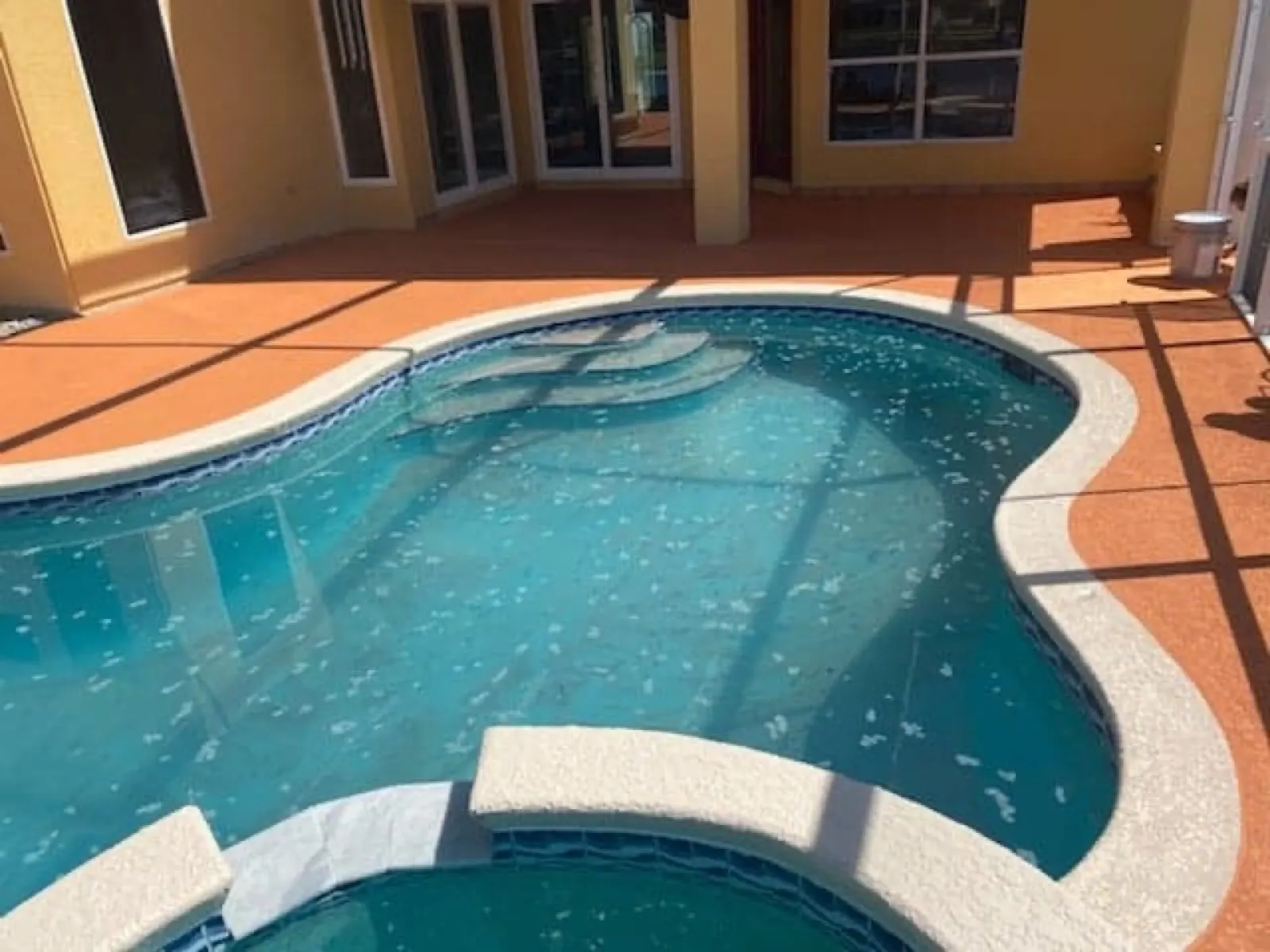
A concrete deck has one more option. A knockdown spray texture in a light color helps with heat. Light spray textures are a standard pool deck coating across the Sun Belt.
Which is less slippery when wet?
Both surfaces can grip well, and the finish makes the difference. A broom finish adds a slip resistant texture to a concrete deck. A knockdown spray texture is highly textured and slip resistant. Pool deck guides rate concrete pavers as durable and slip resistant.
A stamped finish needs the most thought around water. Sealed decorative concrete can get slick, since water tends to bead up on the surface. A clear plastic grit mixed into the sealer makes the surface less slippery. Our stamped finishes are sealed with a grit additive.
What happens where the deck meets the coping?
Coping is the cap along the top edge of the pool. On a new pool, the tile and coping usually go on before the deck. Either surface then meets that set edge. Paver coping can have a bullnose, which is a rounded front edge.
A concrete deck can carry a poured edge instead. The coping and the deck come out as one unit, with no break in the finish. The catch comes later, if the edge ever needs work. A poured edge is part of the slab, so it cannot be lifted and reset the way set coping can.
Set coping can come off and go back on fresh mortar. The pool stays full for that work, and the water level drops a few inches.
Where any deck meets set coping, the joint between them has to stay flexible. The deck and the pool move on their own, whether the deck is poured concrete or pavers. The gap takes a closed cell foam backer rod under a flexible sealant.
Sand does not compress, so a sand filled joint passes deck movement to the coping. Polymeric sand belongs between pavers, but it cures semi rigid, so it stays out of this joint.
How soon can you use a new pool deck?
A broom finished slab takes at least 24 hours before anyone walks on it. Scuffing or twisting feet before then can leave permanent marks. A stamped finish needs about another day, so the release agent can be rinsed off.
Curing starts right after finishing and typically runs 3 to 7 days, while the slab keeps gaining strength. Keep pets off it early on, since claws can dig into the surface.
A spray texture finish is its own coat over the slab. It needs a day or two of cure time after it goes on.
Pavers have no slab to cure, so the pavers themselves can take traffic right after installation. The joint sand is the part that waits. We water the polymeric sand in so it sets up. One sand maker says to keep foot traffic off it for 24 hours.
Rain matters for both surfaces, and a pour needs a dry window. Light rain is no problem for new joint sand. A heavy downpour in the first 24 to 48 hours can knock it loose, though. Brevard summers bring afternoon thunderstorms, so the forecast matters either way.
What does each deck need over the years?
A stamped or spray texture deck carries a sealer, and the sealer wears first. Plan on a fresh coat about every six years, and sooner on a deck in full sun all day. Salt air in the beachside towns is one more reason to keep it current.
On a paver deck, the joints are the upkeep. Joint sand needs refilling now and then, and it washes low at the pool edge first. Pavers fade under Florida sun, and color blends get discontinued, so keep a few spares from the install.
Wherever a deck meets set coping, check the sealant joint now and then. When it splits open, the old sealant gets cut out and fresh backer rod and caulk go in. Beyond that, a concrete deck needs occasional cleaning to keep its looks.
Every deck gets priced on site, from the actual job. When you are ready, book a free on-site estimate.
Frequently Asked Questions
What is the best pool deck material for Florida?
Pavers and poured concrete both hold up around Florida pools, so the best pick depends on your yard. Choose pavers if you want sections that can be lifted and reset later. Choose concrete if you want one continuous surface with a broom, spray texture or stamped finish. Pick a light color either way, since lighter colors stay cooler.
Which pool deck is easier to repair?
A paver deck is. Settled pavers come up and go back down on a rebuilt base, and a broken one gets a matching stone. On a concrete deck, a crack cannot be lifted out. New concrete will not match older concrete in color, so a patch or an add-on reads as a different color.
Can a new deck go in inside a screen enclosure?
Yes, and most Brevard pools sit inside one. No machine fits through a screen door, so concrete gets pumped in or wheeled in. Pavers and base material come in by wheelbarrow, and the pavers get cut around the posts and the screen track. The work runs slower, and the cage stays in place.
Can you build either kind of pool deck?
Yes, we build both, and both get priced on the same free on-site estimate. Deck size and shape set the starting number. Tear-out of an old deck and access through the screen enclosure move it. So do the finish or pattern, deck drains and work at the coping.